1. Sublimation Printing: The Gaming Mouse Pad Standard
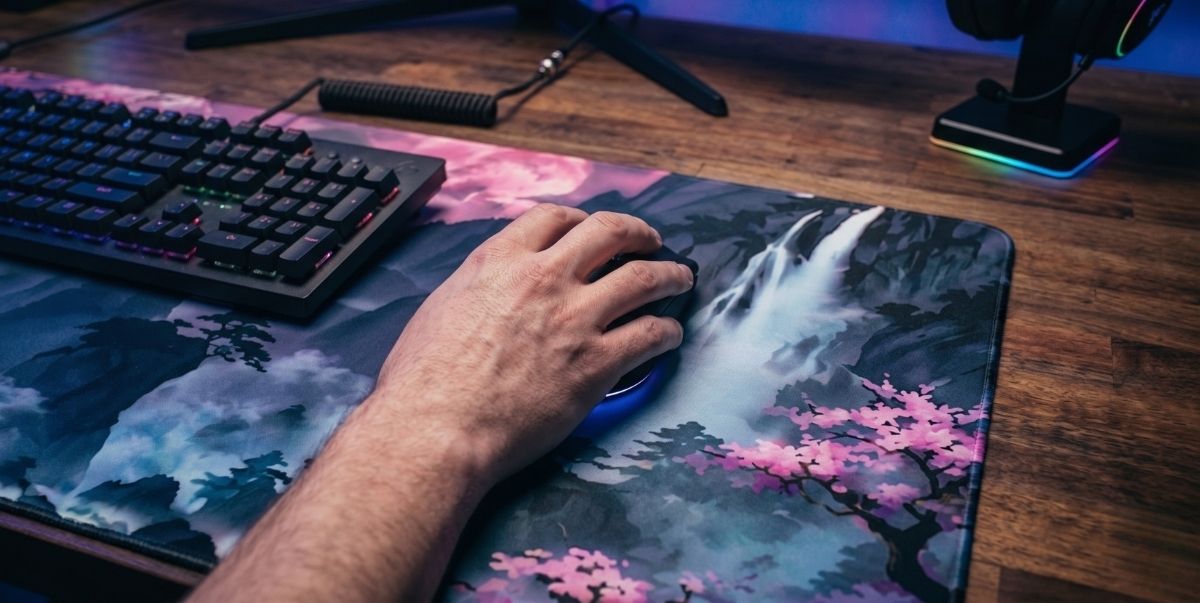
In sublimation, ink is first printed onto a special transfer paper, then transferred to the fabric surface under 180–200°C and pressure. The ink penetrates fabric fibers and bonds with the surface. Result: a fade-resistant, scratch-resistant, washable, photo-quality print.
Sublimation Advantages
- Photo-quality output (600 DPI standard)
- Fade-, water-, and scratch-resistant
- Unlimited color gamut
- Does not break surface integrity
- Washable product
Sublimation Limitations
Sublimation works only on light-colored fabric. Dark designs print correctly; however, because the ink relies on fabric fiber bonding, PVC, plastic, or hard surfaces cannot accept sublimation. Since 95% of the gaming mouse pad market uses fabric surfaces, this is not a practical limitation.
Atak Gaming standard: 600 DPI sublimation across all gaming mouse pad lines. Annual capacity of 5 million units runs entirely on sublimation foundations.
2. UV Printing: For PVC and Hard Surfaces
UV printing cures ink under specialized UV light. Used on PVC, plastic, and hard-surface products. Promotional mouse pad series, card game playmats, and special event products are produced with UV.
UV Advantages
- Works on PVC, plastic, and hard surfaces
- Fast production (cures instantly)
- High color saturation
- Texture/raised effects possible
UV Limitations
UV print sits on top of the surface and can wear off under prolonged mouse abrasion. Not ideal for premium gaming, but cost-effective for one-off promotions, corporate gifts, and short-life-cycle items. Unit cost is 15–20% lower than sublimation.
3. DTF (Direct-to-Film) Printing: The Hybrid Solution
DTF printing transfers an image first to a special film, then to the surface via heat. Like sublimation, it works on fabric; like UV, it also works on hard surfaces. A hybrid solution. Popular in 2024–2026 for small-batch and sampling runs.
DTF Advantages
- Multi-surface compatibility
- Quick setup at low volumes
- White ink support (prints on dark substrates)
- High detail and color saturation
DTF Limitations
For high-volume runs, DTF unit cost is 25–35% higher than sublimation. Since DTF does not fully bond with fabric fibers like sublimation, durability is slightly lower. At Atak Gaming, DTF is currently used for samples and special small batches; bulk orders use sublimation.
4. Quick Reference: Which Technique for What?
- Premium gaming mouse pad (fabric): Sublimation — only option
- XXL desk mat (fabric): Sublimation — only option
- Promotional, corporate gift (PVC): UV
- Small batch, sample, dark substrate: DTF
- High-volume e-commerce orders: Sublimation
5. Cost and Lead-Time Analysis
For a typical 300×250 mm gaming mouse pad, approximate per-unit print costs: Sublimation 0.35–0.50 USD, UV 0.45–0.60 USD, DTF 0.60–0.90 USD. Sublimation is fastest in production: for a 5,000-unit order, the print stage completes in 24–36 hours. UV and DTF require 30–50% more time.
Conclusion
For 2026: in fabric-surface products sublimation is the only premium choice, UV is economical for promotional series, and DTF offers a hybrid solution for small batches and custom requirements. Atak Gaming runs all three under one roof and recommends the most suitable approach per order.
Get a direct factory quote
Detailed wholesale quote within 24 hours — directly from the OEM/ODM manufacturer.